Sunday, January 11, 2015
Monday, September 1, 2014
2014 Update
Hey all,
I haven't been on top of updating this thing since junior year of college so I figured since I'm an alumni now there's no excuse! If you want to see some art not posted on here head over to my portfolio site. There's some new-ish stuff over there to check out :)
As far as my life goes... I'm moving to Washington soon! I wanted to be in the area where all the magic happens and I loved how beautiful WA was when I interned up there so it seems like the opportune place to go. I'll be up there in a month or so, living with my two game art alumni buddies to start my life as a college grad.
Cheers,
-Spencer
I haven't been on top of updating this thing since junior year of college so I figured since I'm an alumni now there's no excuse! If you want to see some art not posted on here head over to my portfolio site. There's some new-ish stuff over there to check out :)
As far as my life goes... I'm moving to Washington soon! I wanted to be in the area where all the magic happens and I loved how beautiful WA was when I interned up there so it seems like the opportune place to go. I'll be up there in a month or so, living with my two game art alumni buddies to start my life as a college grad.
Cheers,
-Spencer
Wednesday, April 24, 2013
Anasazi Project
For my Native American cultures class we had to research a Native American culture, write an essay, and create some form of art based on an important aspect of that culture. I chose the Anasazi people and decided to do a zbrush sculpt of a piece of pottery they might've had.
I really like their design work how it's very clean and almost mathematical in a sense, so I tried to emulate that in the polypainting process.
Monday, January 21, 2013
Dexter Morgan Caricature Sculpt
Done in Maya and Zbrush
I really want to set away more time to do sculpts. They are so much fun and a somewhat therapeutic in a way.
Thursday, December 27, 2012
Winter Break Fun
Friday, December 21, 2012
UDK Fantastic Environment
Our last assignment for the semester in our 3D class was to make a fantastic or stylistic environment based off of the concept art we did earlier in the year. Mine was the Crystal Cavern inspired by Rayman: Origins.
Here's some process stuff!
(Not the final material set up)
And then I did a quick paintover because I wasn't liking the scene at all
And here's a little fly through of the space
Thursday, November 1, 2012
Fire Nation Collaboration
Here is the cinematic that Kenae (http://klowrygad.blogspot.com/),
Sam (http://ringlingssexe.blogspot.com/),
Will (http://wharrisonavery.blogspot.com/),
and I made together of the Assault of the Fire Nation Palace:
Sam (http://ringlingssexe.blogspot.com/),
Will (http://wharrisonavery.blogspot.com/),
and I made together of the Assault of the Fire Nation Palace:
Realistic Fire Nation Palace
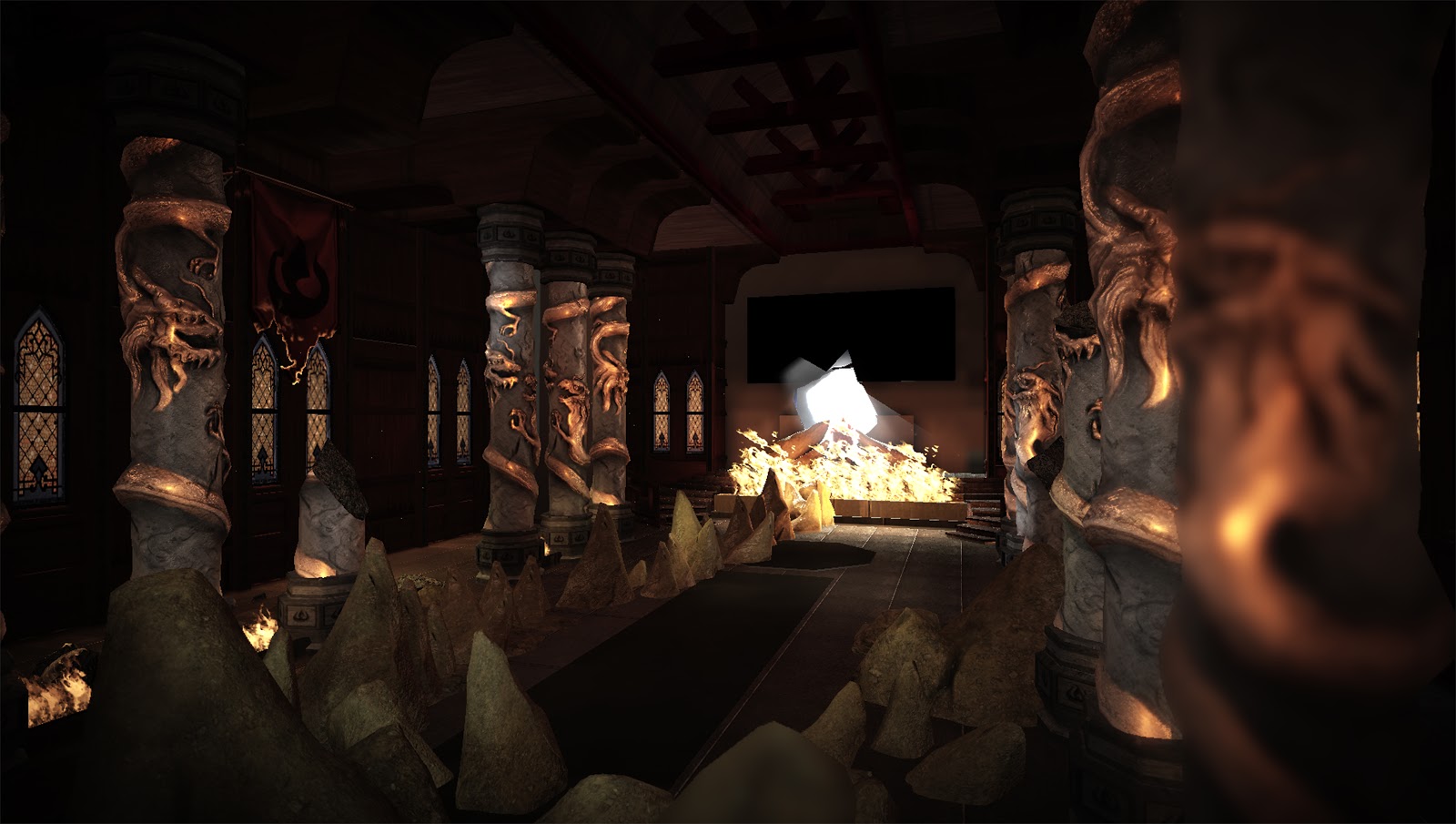
So for our newly completed 3D for Games class our assignment was to take an existing game, or movie and make a realistic version of it using UDK. We modeled all the assets, set-dressed, lit the environments and made camera moves for each of our environments. My group (Kenae Lowry, Samantha Sexe, Will Avery, and I) got to do the Fire Nation Palace from the amazing animated show Avatar: The Last Airbender. We set the time to be about 20 years after the end of the A.T.L.A series to allow us to change up the existing designs.
I was personally in charge of the throne room.
Here are some of my process shots:
The final camera cinematic of all of our scenes together will be posted next!
I was personally in charge of the throne room.
Here are some of my process shots:
I did a paintover to help visualize the lighting better so here is before paintover:
And here's after:
And here are some shots of the final outcome:
I'm pretty proud with this material. It's the vertex paintable flag material.
Monday, October 29, 2012
DFA: "Fantastic Environment"
The next assignment for DFA was to analyze a game that has a non-realistic style and make a painting of an environment in that style that you might see in the game.
For my game I chose Rayman Origins.
Here was my process:
For my game I chose Rayman Origins.
Here was my process:
It was at this point where I decided I didn't like the values and the composition just wasn't doing it for me so I switched it up.
And here is the final turn in:
In our 3D class, after we finish up our realistic environment, we will be making these into a space in UDK. Can't wait for all those hand-painted textures!
Thursday, October 18, 2012
A Beautiful Biome
In 3D for Games our 3rd assignment was to choose a biome (I chose the arctic tundra during summer) and create a nice layout in UDK by making foliage, one rock, and a log, and using the landscape editor. The challenge was to see how versatile your assets could be because you were only allowed to make one rock and log while managing to populate the seen believably. This was my favorite assingment so far this year. I got a lot out of it and I am very happy with my end product.
Here was my process:
Saturday, February 4, 2012
Programming Ball Contraption
This is a small project I did in Programming that uses programming and physics to sort the balls by color and mix them together, then loop around again.
Tuesday, November 22, 2011
Board Game Completion
It's 3:34 a.m here on the fifth floor of Ulla Searing Student Center and Spencer Curtis has just finished making his very own board game!
Third person aside, I am very please with this end product I have made. I put a lot of time and effort into this game and it really paid off. From sculpting miniatures in maya, to engraving wood, to making a board with a router machine, to even hand carving the name of the game onto the box.. It was all worth the effort put in. Though i'm pretty sure my hands will be permanently stained after all of the wood stain I have used.
Here are some pictures of my work station after everything is complete.
P.S- Thats a $20 parking ticket from good ole Ringling for parking in a "visitor" parking spot. Why do they need more money from me?
Third person aside, I am very please with this end product I have made. I put a lot of time and effort into this game and it really paid off. From sculpting miniatures in maya, to engraving wood, to making a board with a router machine, to even hand carving the name of the game onto the box.. It was all worth the effort put in. Though i'm pretty sure my hands will be permanently stained after all of the wood stain I have used.
Here are some pictures of my work station after everything is complete.
P.S- Thats a $20 parking ticket from good ole Ringling for parking in a "visitor" parking spot. Why do they need more money from me?
Sunday, November 6, 2011
Board Game Fabrication
I just bought some wood and wood finish for some of my pieces. About to test out our school's laser engraver for the first time. Hopefully iteration won't be necessary for this part but I am ready for the worst.
Thursday, October 6, 2011
Testing Quoridor Results
Iteration from Game Design Club
Last night at Game Design Club I brought Quoridor and had Jati, Maya, John, and Ignacio play it in 4-player mode. Due to the fact that we only had time for one round, I didn’t get to test my ideas for a mod out but when I asked everyone afterwards what they thought some good mod ideas might be for the game I was happy to see that they wanted a mod I had already thought up!
The first thing that came up in conversation was that it would make the game even more interesting if there were different kinds of gates, like L-shaped gates or U-shaped gates, and that was one of the mod ideas I wanted to use more than most so it was relaxing to know they thought it would be a good idea too. As they played the game they got confused with diagonal jumping and whether it applies in certain situations, and that is one of the few things I don't like about Quoridor is that it doesn't give a detailed description of when diagonal jumps can be made, so I might either nix it all together or come up with concrete rules that can't be misconstrued. They also mentioned how the game currently doesn’t have much of a theme at all, which is another asset I knew I wanted to add when modifying Quoridor. I talked about one idea for a theme I came up with when brainstorming, which was farm animals, and everyone just looked at each other with unimpressed expressions on, wondering if I was joking. I see no shame in making a game about farm animals attempting to escape their pens, I think one of the reasons Chris Lewis’ game mod was so successful was because of his clever story he told with his game. Granted, I know my idea isn’t nearly to that level yet, but that is the level of creativity I want to have when making my mod. I probably won’t stick with the farm animal concept, mainly because I haven’t explored the myriad options of themes yet, but I think it’s a better starting point than zombies, aliens, soldiers, terrorists, or anything else that is having the life squeezed out of it in today’s games and media.
When watching people play my game in 4-player mode there is always this interesting mechanic that just develops on its own as the game progresses, and that is the sacrificing of your chance to win in order to prevent another person from winning. Basically when the game is coming to a close you will usually have 2 players who are neck and neck, a player who is too far away to be able to win but has the most gates left, and then a player who has no gates and has no chance of winning. The 2 players who are neck and neck have to rely on the player who has the gates to determine who will win the game. This is just a generalization but it has happened quite a few times from the games I have watched or taken a part in. So it would seem that in the game of Quoridor it is best to be a gentleman/kind lady when playing, because if you’re talking smack the whole time and you’re neck and neck with someone else, the person who controls your fate will not choose you to win.
All of this teaming up and ganging up sparks the notion of a cooperative mechanic, but I am finding difficulties in how to make it work when in the end players are fighting for themselves.
So as of right now I’m going to keep thinking of ways to make this game NOT be Quoridor. It’s really difficult because Quoridor is such a well balanced, elegant game, that it just makes it hard to stray away from a great thing. After I find those mechanics I need I can then come up with the overarching theme and bring it all together.
Wednesday, October 5, 2011
Brainstorming For Board Game Mod
Things Quoridor has going for it:
· Simple ruleset that allows for emergent complexity
· Elegant board design
· Fast gameplay
Things that could make it more interesting:
· An overarching theme
· More simple mechanics to add to the emergent complexity
· Unique pieces to support the theme
A lot of people tend to forget what color piece they are so making each piece unique will be key to solving this problem.
What if my game…
1) Has upgrade abilities?
When you reach half way you can do two things in a turn instead of one
2) Lets you move your gates after they’ve been set down?
This could be done by giving up something in return for the ability to move a gate that’s already in play
3) Uses dice or cards to give it a random nature?
4) Has smaller in-game goals like points?
5) Uses different shaped gates for more variation?
Normal gates, L-shaped gates, U-shaped gates; the number of which gets distributed out in accordance to their power to affect the board.
6) Uses a different shaped board?
7) What if my game had diversions?
Like if a player laid down something on one of the squares the other players had to reach it to move on.
8) Was simpler than it already is?
9) Is about farm animals escaping from a sadistic farmer?
10) Allows players to slip up but punishes them?
Allow them to completely block another player from getting to their goal line but punishes them by sending them back to their home line and lets the opposite player take a gate off the field.
11) Has paralyzing and speed squares, which make you draw a corresponding card?
These squares could make you lose a turn all the way to have the ability to move 3 times in one turn.
12) Gives players a chance to change their end goal while the game unfolds?
Combine this with #7 to make it so that a player who has no gates left can pick a spot anywhere on the board and choose a player who has to reach that spot instead of their original goal.
13) When played with 4 people has a coop attribute?
14) Limits the distance a player can set a gate in relation to their position on the board?
15) Makes players second-guess the decisions they make?
16) Has magnets to make movement easier?
The pieces in Quoridor are too light and always get knocked over.
17) Gives players a chance to redeem themselves late in the game?
18) Gives the players an ability to swap places with another player?
19) Encourages players to set down gates earlier in the game?
20) Penalizes players for not setting down all of their gates?
Tuesday, September 13, 2011
Quoridor Deconstruction
Quoridor
Deconstructed by: Spencer Curtis
Quoridor is an abstract strategy board game played with 2 or 4 players created by Mirko Marchesi and published by Gigamic Games. Quoridor won the Mensa Mind Game award in 1997 and the Game of the Year Award in USA, France, Canada, and Belgium.
Goal of the Game: The sole purpose of this game is to reach your opposite baseline before your opponent(s). In trying to accomplish this you will need to place fences in order to block the other player(s) and move strategically along the board.
The Core Mechanics: In the game of Quoridor the mechanics are simple; a player chooses on his/her turn to do one of two things: move their pawn one space or place a fence down to block another player. Because this game has such elegant mechanics you will never see the same game played twice.
Space of the Game: The physical board of Quoridor can be seen below. It is a beautiful yet simple design consisting of 9 rows and 9 columns of squares in the play area. To the sides there are spaces to store each player’s fences and in between each square in the play area there are grooves for the potential placement of fences during game play.
Objects, Attributes, and States: As seen above, within the game of Quoridor there are 3 different types of objects: the game board itself, the 4 pawn pieces, and the 20 fence pieces. Within the Quoridor game box you will find these items along with a rulebook and a pouch for your pawns and fences. The pawns’ attributes in game play are that they can move one space at a time either horizontally or vertically frontwards, side-to-side, or backwards. If there is a fence in front of a pawn then a state occurs where the pawn must find a way around the fence to get to its opposite baseline. We mentioned how the pawns are only able to move horizontally or vertically in space, however there are certain instances where the pawn is eligible to move diagonally. Let’s take a look at some examples. For the sake of these pictures let’s assume it is the white pawn’s turn:
In this example we can see that the red pawn is adjacent to the white pawn so in the white pawn’s turn it can go either left, right, backwards, or diagonally to the left or right of the red pawn.
So those are some examples of pawn states, lets now take a look at a fence’s attributes:
In this picture we can see two ways that the fences can be placed legally and one placement that is illegal. Fences can be placed vertically or horizontally but only if they occupy two squares. With that being said we can see that the fence placed furthest right is an illegal placement, as it doesn’t occupy two squares.
Actions: Before the game starts you must set up the board. If you are playing with two people then put the two pawn pieces opposite each other on their baselines in the middle square. With 4 people you simply do the same with the other two pieces. When playing a two-player game each player has 10 fences so you would need to put the fences in their storage slots. With 4 players each player has 5 fences. Usually I like to keep my fences in front of me so they don’t get confused with another player’s.
Operative: The two main actions of Quoridor are moving your pawn piece and placing a fence.
Resultant: In doing these actions you may block another player or elongate their path to the side they need to get to. In 4-player games you’ll find that when 1 or 2 players don’t stand a chance any longer they may gang up on another player and use their fences solely to make sure that player doesn’t win. This is the experience one finds when playing with more people. Either it’s everyone for themselves or it’s everyone against you.
Rules: The objective of the game is to get to the other side first which is why probably the most important rule is that you must leave an opening for your opponent(s) to get to their goal baseline. This means that you cannot use your fences to completely block someone off from reaching their goal. You may elongate and wind their path to your liking but there must be a way for them to reach their opposite side. Placing the fences properly is another rule to follow when playing Quoridor. The picture above shows what placements are legal and which are not. Players must keep in mind they can only move once per turn or set one fence per turn not both. Once you run out of fences you must move your pawn every turn. Fences cannot be moved once they’re placed and pawns cannot jump over fences for any reason. With all of that being said the game of Quoridor is pretty simple in understanding how to play, it’s the strategy that is tricky.
Skills Players Learn: As I mentioned previously there are an innumerable amount of options when playing this game, which gives it its great playability. I have played it several times already and not once have I encountered two similar games. Here are a couple examples of end game shots:
In this game I was white and my fence storage column is the empty one on the right. My goal was to make it up while red’s was to make it down, and even though neither of us had reached our opposite baseline we could see that white has been defeated. White, having no more fences left and having more squares to travel to win the red, automatically loses. Since we knew this much we didn’t have to finish the game. Red was the victor.
Throughout playing this games countless times with others I found the key element in this game is to use your fences wisely. The majority of the time I lost it was because I had used my fences too soon and too recklessly. This game relies 100% on the players’ deduction abilities. There is literally no luck involved, only strategy, which is why it is so important to always keep an open mind and try different techniques, because just like Chess, this game focuses on the other player’s mistakes to help you win.
The Reed Strategy: This opening consists in placing, during the first two moves of the game, two walls on the third row in front of the opponent with a single gap in the middle. This opening is attributed to Dr. Scott Reed (Edinburgh, UK), a known military strategist and frequent player. A counter-strategy to the Reed opening is to place two horizontal walls on the third row, one at the extreme left and one at the extreme right, which effectively reduces both players' path counts.
The Shiller Opening: Players 1 and 2 advance their pawns three times each, then player 1 places one wall vertically at the bottom of player 1’s board, providing two paths for player 2 to win while maintaining just one path for player 1. The Shiller opening implements the strategy of maximizing the opponent's path count and of minimizing one's own path count. Larry Shiller (Wilton, CT) is a known math educator, software author and consultant, and author of an upcoming book on Quoridor strategy.
Subscribe to:
Posts (Atom)